



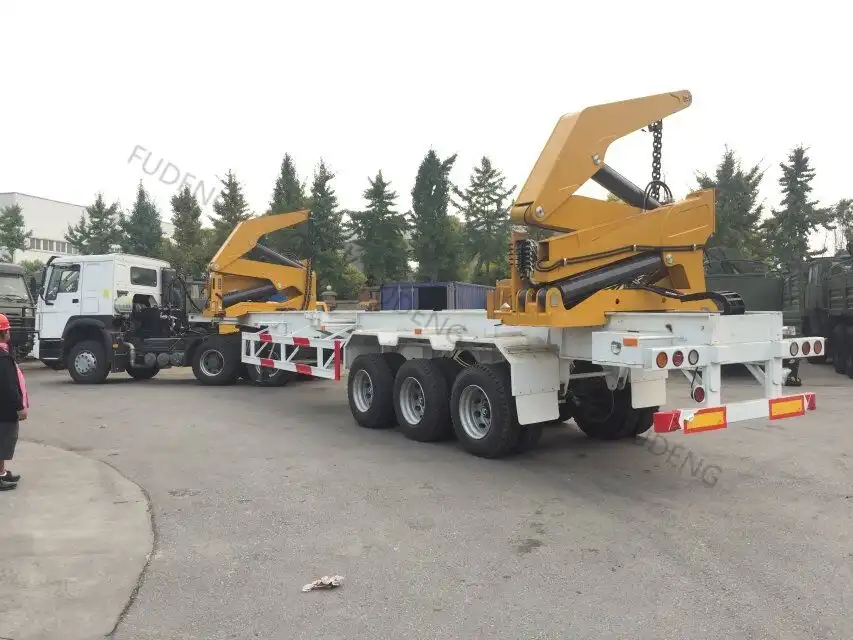
Sideloader is a small, flexible, and versatile loading equipment commonly used in construction sites, mines, ports, logistics parks, and industrial plants. Its core advantage lies in its compact yet versatile design, capable of completing various tasks such as loading, handling, stacking, and excavation in narrow spaces.
Side loaders have become a “universal tool” in modern urban construction, logistics, mining, ports, and other fields due to their small size, versatility, low cost, and easy maintenance. If your project:
Need to frequently load, unload, transport or stack in narrow spaces
Pursuing low operating costs and high operational efficiency
Strict requirements for environmental noise
So the side loader is undoubtedly the best choice. On the contrary, if you are facing large-scale earthwork, deep excavation, or high load lifting, traditional loaders/excavators are the more suitable solution. Only by matching equipment according to project requirements can we truly achieve a win-win situation of cost and efficiency.


1. Small size and strong maneuverability
Dimension side loader, traditional loader/excavator
Body size 3-6 m (length) x 2-3 m (width) usually>10 m
Turning radius 3-5 meters 10-15 meters
Easy access to construction sites through narrow alleys, warehouse doors, and bridges that require demolition or diversion
Obstacle crossing ability is limited by tires/tracks through slopes, gravel, and gravel piles
Applicable scenarios
Urban construction sites: narrow streets and numerous temporary enclosures.
Warehouse logistics: goods are densely stacked and require quick handling.
Mining/Quarry: The width of tunnels and mine entrances is limited.
Port loading and unloading: The dock is narrow and requires fast loading and unloading.
2. Diverse tasks and powerful functions
Side loaders can be equipped with various accessories to achieve multiple tasks:
Main functions and typical uses of attachments
Bucket loading, handling, stacking earthworks, sand and gravel, wood, and waste materials
Shovel excavation, deep excavation, small excavation, earthwork excavation
Combination of shovel and bucket for lightweight excavation and loading
Inclined plate inclined loading inclined stacking, inclined stacking
Grab bucket material grabbing, handling crusher, ore, steel bars
Wire rope hoisting, light cable hoisting, cable hoisting
Hydraulic shovel deep excavation, earthwork excavation engineering excavation, mining excavation
Case: In a demolition project in a certain city, the side loader was equipped with a bucket to complete earthwork handling, and a grab bucket was equipped to complete steel bar dismantling. A single machine completed three tasks, reducing the construction period by 30%.
3. Low operating costs and easy maintenance
Cost Project Side Loader Traditional Loader/Excavator
Low fuel/electricity consumption (1-2 liters/hour) and high (5-10 liters/hour)
Low and high maintenance frequency
Low and high cost of spare parts
Low training cost (operators can quickly get started) and high (professional training required)
Fuel/Electricity: Side loaders generally use diesel or electric drive, with low power and low fuel consumption.
Maintenance: The structure is simple, and regular maintenance (changing oil, filter, hydraulic oil) is sufficient.
Spare parts: The cost of replacing accessories is low, and parts can be purchased from local merchants.
Cost savings: Under the same workload, the operating cost of side loaders can be reduced by 40% -60%.
4. Improve homework efficiency and shorten project duration
Quickly switch attachments: Most side loaders can complete attachment replacement within 5-10 minutes, greatly improving on-site operational efficiency.
Same machine multifunctionality: No need for multiple devices, reducing device footprint.
High frequency operation: suitable for processes that require frequent loading, unloading, and handling, with long continuous operation time and short downtime.
Statistics: A certain mine uses side loaders for daily stacking operations, with a single machine stacking 500 tons per day, completing a 3-day stacking task and saving 2 traditional loaders.
5. Environmental and safety advantages
Low emissions: Diesel models adopt efficient combustion technology and comply with Euro III/Euro IV emission standards; Electric side loaders have zero emissions.
Low noise: With a small body and compact structure, the noise level is lower than traditional large loaders, making it suitable for urban construction sites.
High safety: Operators can monitor both sides of the aircraft simultaneously, providing a wider field of view; The aircraft has a low center of gravity and low risk of overturning.
Case: During construction in urban residential areas, the electric version of the side loader operates at night with a noise level of only 60 dB, fully complying with local residents’ noise restrictions.
6. Adaptability and Future Upgrades
Modular design: The body, hydraulic system, and drive system of the side loader can be upgraded according to requirements.
Intelligence: Modern side loaders can be equipped with GPS, automated control, remote diagnosis, and improve production management level.
Electric/hybrid power: In the future, zero emissions can be achieved through retrofitting to meet stricter environmental regulations.


WhatsApp us